


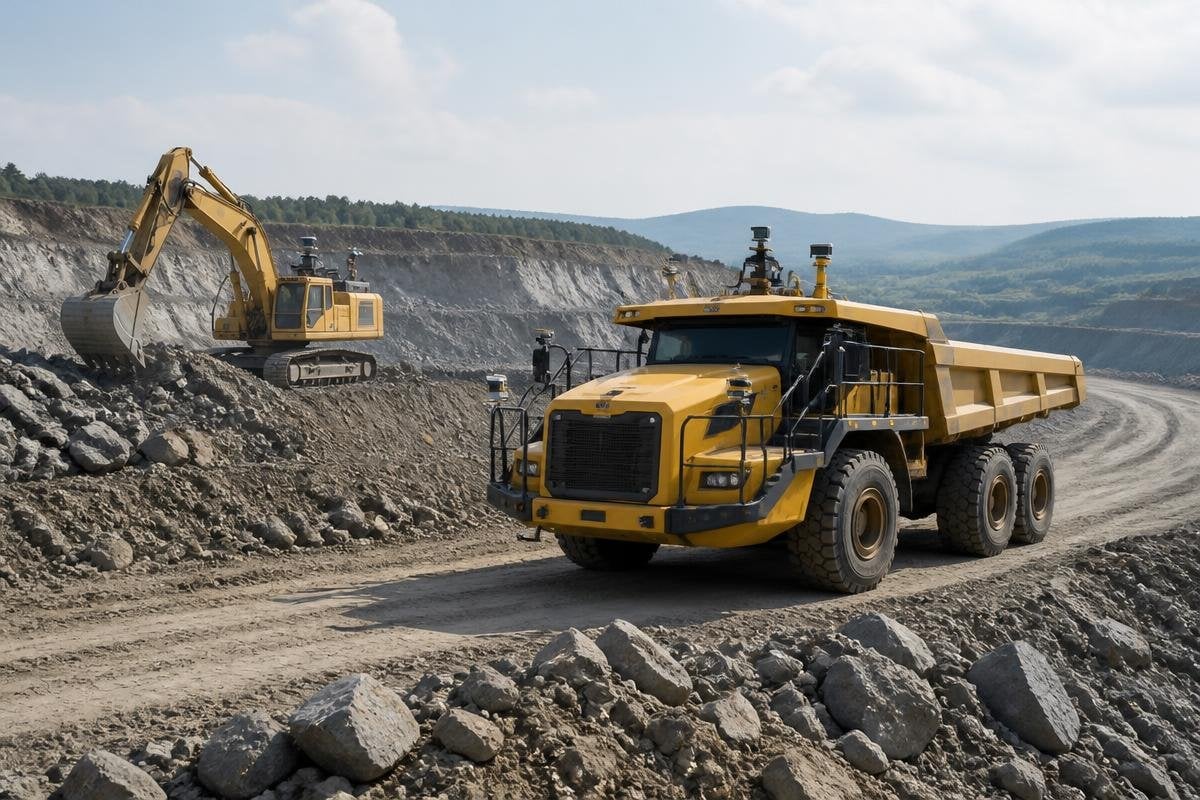
An autonomous excavator or haul truck has to work around people, loose ground, changing weather, and machines that were never designed to share control. The useful question is no longer whether the machine can move on its own, but which parts of a job it can finish safely and repeatedly.
Quick read
- Sensors such as LiDAR, cameras, and GNSS give the machine different views of its work area
- Remote operators will still handle unusual conditions and blocked routes
- Buyers need proof from the exact site, task, and material they plan to use
Where autonomy can help first
Heavy equipment follows repeated paths and performs repeated motions. A haul truck can travel between a loading point and a dump area. A dozer can push material along a planned grade. An excavator can dig within a marked zone, then place the load in a known area.
Those tasks give software a clear map and a limited set of actions. The machine can check its position, compare the planned path with new sensor data, and slow or stop when the scene changes. A human operator may then take control when the machine finds a condition outside its work plan.
This approach fits sites with defined boundaries and repeatable work. It fits a loose, changing jobsite less easily, where a new trench, parked truck, or person can change the safe route within seconds.
The machine still needs several kinds of sight
A single sensor cannot describe a heavy-equipment site well enough on its own.
LiDAR measures distance and can help build a 3D view. Cameras can identify signs, people, and surface features. Global navigation satellite system data, or GNSS, gives the machine an outdoor position, though trees, buildings, and local interference can reduce that signal.
The control system also needs machine data. Hydraulic pressure can show how the arm is loading. Wheel speed can reveal a loss of grip. Engine temperature, battery level, and brake status can decide whether the machine should keep working or stop.
These inputs must agree often enough for the machine to act. If the map says a route is open but a camera sees a person, the safe choice is to stop and ask for help. That pause may cost time, but a system that keeps moving through uncertainty has no place near a crew.
Remote control will remain part of the job
Autonomy does not remove the need for skilled people. It changes where they work and what they watch. One operator might supervise several machines during routine work, then take control of one machine when it reaches soft ground, a blocked lane, or an object the sensors cannot classify.
That handoff needs a clear link, a useful view from the machine, and controls that respond without delay. The site also needs a plan for a lost connection. The machine should stop in a safe place or follow a known recovery action, rather than wait for someone to guess what happened.
Dated autonomous equipment reporting can tie a machine’s claimed ability to the terrain, load, and recovery plan waiting on the jobsite.
The hard limits are on the jobsite
Dust can cover cameras. Rain can change the surface and reduce visibility. Loose rock can shift beneath a wheel after the machine has planned its route. A radio link can fail behind a cut slope or a steel structure.
Software can respond to some of these conditions, but no buyer should treat a demonstration on a prepared area as proof of site performance. Ask to see the machine work on the material, slope, traffic pattern, and weather range that match your site. If those tests are missing, the main claim remains unproven.
I’d wait before buying a system that gives a clean demo but cannot show how it stops, calls for help, and resumes work after a fault.
A buyer’s site check
Use these points before you approve an autonomous machine for a live project:
- Define the task: record the exact loading, digging, grading, or hauling motion
- Map the limits: mark slopes, soft ground, exclusion zones, and routes that change
- Test the stop state: confirm what happens after sensor loss, link loss, or low power
- Set the handoff: name who takes control and how they see the machine’s surroundings
- Measure the work: compare completed cycles, stops, operator time, and manual recovery
- Plan the edge cases: include parked equipment, workers on foot, dust, rain, and night work
The next useful proof will come from machines working through ordinary site problems, not from longer demonstrations on empty ground. Buyers should ask for task records, fault logs, and recovery times before they count autonomous heavy equipment as ready for their site.
