


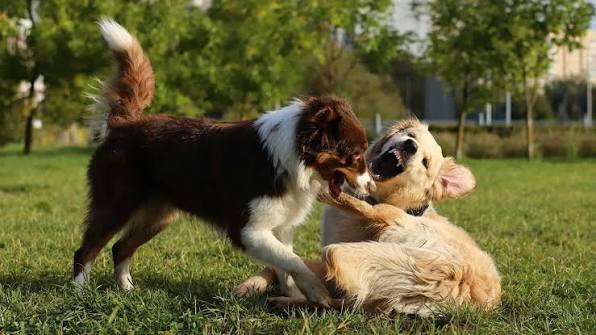
Aggressive dog behavior training can help owners better understand and manage behaviors such as lunging, growling, barking, snapping, or biting. These behaviors can have different underlying causes, including fear, frustration, territorial responses, resource guarding, pain, or learned patterns. Addressing the behavior requires more than simply correcting the visible reaction.
Effective behavior work focuses on identifying triggers, improving communication, building reliable responses, and creating situations in which the dog can succeed. With consistent handling and an individualized approach, owners can make meaningful progress while prioritizing safety.
Understanding Aggressive Dog Behavior
Aggression is a description of behavior, not necessarily a complete explanation of why a dog behaves that way. A dog that growls when approached while eating may have different motivations from a dog that lunges at unfamiliar dogs during walks.
Common signs can include:
- Growling or snarling
- Lunging toward people or animals
- Excessive barking
- Stiff body posture
- Showing teeth
- Snapping
- Chasing
- Biting
- Guarding food, toys, spaces, or people
Understanding the context surrounding these behaviors is an important first step. Owners should consider what happened immediately before the reaction, what the dog was exposed to, how close the trigger was, and what happened afterward.
This information can help reveal patterns that are easy to overlook during everyday interactions.
Why Aggressive Behavior Can Develop
Dogs learn from their experiences and environments. A dog that repeatedly discovers that barking or lunging makes an unfamiliar person move away may learn that the behavior produces a desired result.
Fear can also play an important role. Some dogs react aggressively because they feel threatened and are attempting to create distance from something they perceive as dangerous.
Other contributing factors can include:
- Limited socialization during puppyhood
- Previous negative experiences with people, dogs, or environments
- Resource guarding involving food, toys, or resting areas
- Frustration caused by barriers or restricted access
- Territorial behavior around homes, yards, or vehicles
- Inconsistent responses from handlers
- Physical discomfort or medical issues
Because multiple factors can overlap, treating every aggressive response in exactly the same way may not address the underlying problem.
Aggressive Dog Behavior Training Should Start With Safety
Safety should come before behavior goals. If a dog has demonstrated a willingness to bite or has seriously injured someone or another animal, owners should avoid situations that unnecessarily expose people or animals to risk.
Management can include using appropriate physical barriers, maintaining distance from known triggers, securing gates and doors, and planning walks around environments where the dog can remain under control.
Owners should also avoid forcing a dog into close contact with a trigger in an attempt to make the dog “get used to it.” Flooding a fearful or reactive dog can increase stress and potentially make the response more difficult to manage.
Professional guidance can be especially valuable when aggression involves biting, unpredictable reactions, children, multiple animals, or rapidly escalating behavior.
Identifying Triggers and Thresholds
One of the most useful concepts in dog behavior training is the threshold. This refers to the point at which a dog becomes so emotionally aroused that responding to cues becomes significantly more difficult.
For example, a dog may notice another dog from 100 feet away and remain relatively calm. At 20 feet, however, the dog might begin staring, stiffening, barking, or lunging.
Training is generally more productive when the dog remains below that point of escalation.
Owners can keep a simple behavior log that records:
- The trigger
- The location
- Approximate distance from the trigger
- Early body-language signals
- The dog’s response
- How long recovery took
- What helped the dog settle
Over time, these observations can provide useful information about patterns and progress.
Building Better Responses Through Positive Reinforcement
Aggressive dog behavior training is not simply about stopping unwanted actions. It can also involve teaching the dog what to do instead.
A dog that reacts to another animal might learn to look toward the handler, move away, sit, or focus on a familiar cue. Reinforcing these alternative behaviors gives the dog a clearer response to situations that previously produced an unwanted reaction.
Useful foundational behaviors can include:
- Name recognition
- Reliable recall
- Hand targeting
- Loose-leash walking
- Sit and stay
- Attention cues
- Calm settling
- Moving away from a trigger
Rewards should be delivered at the right moment. If the dog notices a trigger and remains calm enough to respond, reinforcing that calm behavior can help strengthen the desired pattern.
Consistency Matters More Than Occasional Training
Behavior change rarely comes from a single training session. Dogs learn through repeated experiences, which means owners need to apply the same expectations across everyday situations.
For example, if jumping, barking, or rushing toward visitors is sometimes rewarded with attention but discouraged at other times, the dog may receive conflicting information.
A consistent household can establish clear routines for:
- Greeting visitors
- Feeding
- Walks
- Doorway behavior
- Interactions with other animals
- Access to furniture or resting areas
- Handling and grooming
Consistency does not mean using harsh corrections. It means making expectations predictable and reinforcing behaviors that owners want to see more often.
When Professional Behavior Support Is Appropriate
Some behavior problems are complex enough that owners should not attempt to solve them alone. A professional trainer can observe the dog’s behavior, identify patterns, develop a management strategy, and help the owner practice techniques safely.
This is particularly important when a dog has a bite history or when aggressive behavior occurs around children or other vulnerable individuals.
Owners should also consider veterinary evaluation when aggression appears suddenly or changes significantly. Pain and other medical factors can sometimes influence behavior, so ruling out health-related contributors may be an important part of a comprehensive approach.
Creating Long-Term Progress
Successful behavior modification is often measured by more than whether a dog completely stops reacting. Progress may involve a dog recovering more quickly, responding to its handler sooner, tolerating greater distances, or experiencing fewer incidents.
Owners can support long-term improvement by maintaining realistic expectations and avoiding unnecessary setbacks.
A practical approach includes:
- Identify and manage predictable triggers.
- Learn to recognize early stress signals.
- Work at a manageable distance.
- Reinforce calm and alternative behaviors.
- Practice foundational obedience regularly.
- Increase difficulty gradually.
- Track progress rather than relying on memory.
- Seek professional help when safety or complexity requires it.
The goal is to create reliable behavior while helping the dog develop better ways to respond to challenging situations.
A More Thoughtful Approach to Dog Behavior
Aggressive dog behavior training can help address stressful behaviors in a structured way, but reacting emotionally or relying exclusively on punishment does not necessarily address why the behavior occurs. A thoughtful training plan considers the dog’s environment, history, triggers, communication signals, and ability to cope with challenging situations.
With appropriate management, structured training, and consistent reinforcement, owners can work toward safer and more predictable interactions. Every dog is different, so an effective plan should reflect the individual animal rather than relying on a one-size-fits-all formula.
For owners looking for professional guidance and practical strategies tailored to their dog’s needs, Rob’s Dog Training provides dog training resources and services designed to help owners better understand and manage challenging behavior. To learn more about available training solutions, visit robsdogs.
